Water Damage Cleanup for Lake Norman Homes
Living on Lake Norman changes what water damage looks like. It's not just the storm that soaked your carpet. It's the crawlspace that stays humid because the lake sits fifty feet from your foundation, the dock electrical that took on water during a high-release week, and the finished lower level built at an elevation that made sense until the lake didn't cooperate. We work these differently than an inland job, because they are different.
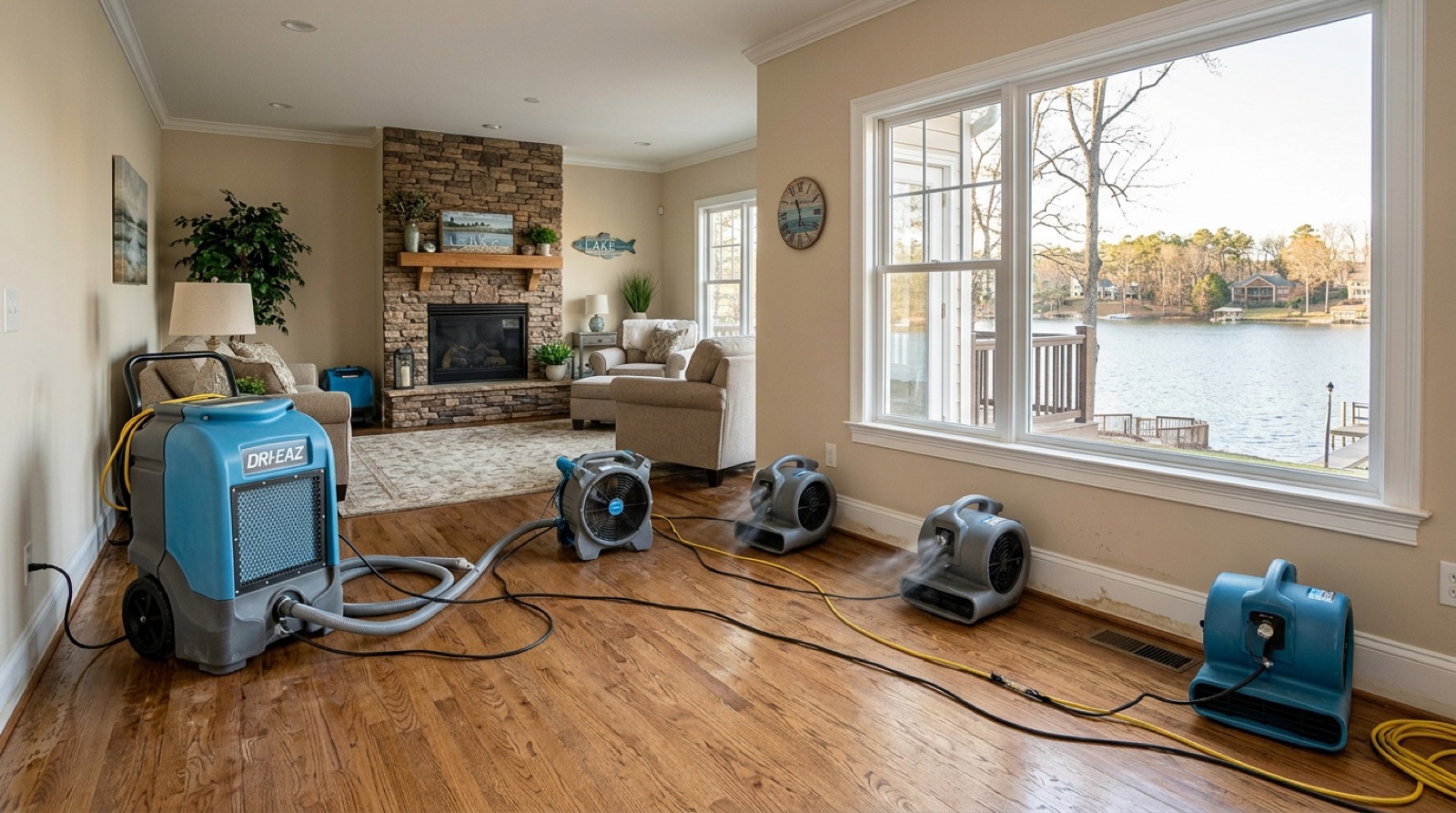
The lake itself is part of the problem
Lake Norman isn't a natural lake. Duke Energy built it in 1963 by damming the Catawba River at Cowans Ford Dam, and the utility still operates it today as part of a chain of reservoirs running down through the Charlotte area. That matters for anyone living near the shoreline, because Duke Energy manages the lake's level for hydroelectric generation and flood control, not for your crawlspace's convenience. Full pond is set at an elevation around 760 feet, and the utility raises or lowers that level based on rainfall across the entire Catawba River basin, which stretches well up into the foothills and into South Carolina.
That's the part most homeowners miss. Your yard can be bone dry and your lake level can still be rising, because it rained forty miles upstream three days ago. A sustained high-release period pushes water higher against seawalls, boathouses, and crawlspace vents than a normal week would, and it can do that with zero rain falling on your own property. If you've ever wondered why your crawlspace flooded on a clear day, this is usually why.
Docks, boathouses, and HOA rules
Most established communities along the lake in Huntersville, Cornelius, and Davidson operate under an HOA with specific rules governing docks, boathouses, and shoreline structures, since Duke Energy's shoreline management program requires permits for anything built below the full pond line. That adds a wrinkle when water damage touches a boathouse or a dock-adjacent structure: repairs sometimes need HOA sign-off or a shoreline permit before work starts, on top of the normal insurance and cleanup process. We've worked enough of these jobs to know to ask about HOA requirements on the first call, not after we've already started.
Boathouse and dock electrical is its own risk category. Older lakefront properties sometimes still run electrical to boat lifts and dock lighting on circuits that were never designed for a sustained high-water event. If your dock area flooded along with the house, treat the electrical there with the same caution as anything inside, don't assume it's fine just because it's outdoor equipment.
What it costs
Pricing for lakefront water damage runs close to our standard ranges, with one difference: crawlspace and lower-level jobs near the shoreline tend to land toward the higher end because of persistent ambient humidity that slows drying.
Emergency water extraction: $395 to $1,150.
Structural drying: $1,200 to $4,800, lakefront crawlspace and lower-level jobs typically run mid-to-upper range.
Crawlspace drying: $650 to $2,400, vented crawlspaces near the shoreline usually run toward the top of this range due to lake-effect humidity.
Flooded basement or lower-level cleanup: $900 to $4,200 for below-grade square footage.
How we work a lakefront job
- Confirm the water source. Storm runoff, a plumbing failure, and lake-level intrusion each call for a different protocol, and lakefront properties are more likely than an inland home to have more than one source contributing at once.
- Check dock and boathouse electrical if the water reached that area, before anyone touches equipment near it.
- Extract standing water with truck-mount equipment, working from the lowest point in the structure upward.
- Map crawlspace and lower-level humidity separately from the rest of the house, since lake-adjacent spaces run a different baseline than interior rooms.
- Flag any HOA or shoreline permit requirements if the damage touches a dock, boathouse, or anything below the shoreline management line, so you're not caught off guard later.
- Dry and monitor daily until readings hit target, tracking lakefront spaces a few extra days past what an inland job typically needs.
Where this shows up most
We see this pattern most often in shoreline-adjacent communities along the Jetton Road and West Catawba Avenue corridor in Cornelius, and in the Davidson Bay and Davidson Landing pockets along the water in Davidson. Both areas mix older homes built before crawlspace encapsulation was standard with newer construction that handles lake humidity better but still isn't immune to a sustained high-release period. Homes set back from the water aren't off the hook either. Lake-effect humidity travels further inland than most people expect, especially into crawlspaces that already run damp from Piedmont clay soil.
How long it takes
A standard lakefront extraction and drying job runs 3 to 6 days, a day or two longer than a comparable inland job because ambient humidity near the shoreline slows how fast a dehumidifier can pull a room down to target. Jobs involving a boathouse or dock structure can take longer if HOA or shoreline permitting is required before repairs can proceed, that part isn't something we control.
One limit worth stating plainly: we don't do shoreline construction, dock repair, or boathouse rebuilds. We handle the water damage cleanup and drying. If your dock or boathouse itself needs structural repair, that's a marine contractor's job, and we'll say so rather than take on work outside what we actually do.
Questions lakefront homeowners ask
Can lake level really flood my crawlspace without local rain?
Yes. Duke Energy adjusts Lake Norman's level based on rainfall across the whole Catawba River basin, which includes areas well upstream of Huntersville. A sustained high-release period can push water against a shoreline-adjacent crawlspace even on a dry week here.
Is dam-related flooding covered by my homeowners policy?
It depends on your policy and whether the water is classified as flood versus a covered peril. Standard homeowners policies typically exclude flood damage, which is why many lakefront owners carry a separate flood policy. Check your declarations page, and see our insurance claim guidance page for how we document either scenario.
Do I need HOA approval before you start drying my house?
No, interior water damage cleanup doesn't typically require HOA sign-off. It's specifically dock, boathouse, and shoreline structure repairs below the full pond line that often need HOA or Duke Energy shoreline management approval.
Why does my crawlspace stay humid even when it hasn't rained?
Lake-effect humidity moves through vented crawlspaces regardless of local rainfall, and it travels further inland than most homeowners expect. Combined with Piedmont clay soil that holds ground moisture, shoreline-adjacent crawlspaces run a higher baseline humidity most of the year.
Do you work waterfront homes that aren't in an HOA community?
Yes, plenty of shoreline properties around Huntersville, Cornelius, and Davidson are standalone parcels without an HOA. The lake-level and crawlspace issues are the same either way, HOA involvement only changes the dock and boathouse repair side.
Tell us what's going on
Serving Huntersville, Cornelius, Davidson, and north Charlotte.